Showing posts with label Fresh Water Generators. Show all posts

Friday, 27 March 2015

Application, Features and benefits of Freshwater generator

The Freshwater generator is a major advance based on proven by expertise. Freshwater generator optimized process cuts seawater needs in half, which minimizes pipework and allows the installation of smaller seawater pumps. This in turn reduces installation costs, fuel consumption and CO2 emissions.
Freshwater generator makes use of 3 in1 plate technology, which enables desalination in a single plate pack with one type of titanium plate. Since the plate pack also contains the process vacuum, freshwater generator has no outer shell and is smaller than other freshwater generators. The plate pack slides open for easy access to the interior without an additional service area.
The use of corrosion and erosion-resistant titanium, combined with an optimized process that inhibits natural scaling, ensures that freshwater generator needs little maintenance. The system has been fully tested both on and off shore, and is designed to last the lifetime of the ship.

Application

Freshwater generator uses vacuum distillation to convert seawater into high-quality freshwater for domestic and process utilization. By providing a constant supply of low-salinity water and continuously controlling the water quality, it eliminates the need for bunker water.
Freshwater generator is designed for automatic operation in periodically unmanned engine rooms and other automated operations. Jacket water, steam injection or a Hot Water Loop can all be used as heating media.

Features and benefits

  • Half the seawater flow

    Compared to other freshwater generators only half the seawater is needed, which means smaller seawater pumps can be used. Optimized distribution prevents dry spots and inhibits the natural scaling process.
  • Lower costs and emissions

    The reduction in seawater pumping needs has a corresponding effect on the consumption of electrical energy. Less fuel has to be burned, which reduces both operating costs and CO2 emissions.
  • 3-in-1 plate technology

    Freshwater generator incorporates the evaporation, separation and condensation processes into a single type of titanium plate. Desalination is handled within a single plate pack that also contains the process vacuum. No outer shell is necessary.
  • Simple, compact installation

    With no outer shell and no additional service area, Freshwater generator has a minimal weight and footprint. Assembly can be handled on site and installation is simplified by the ability to use smaller seawater pumps and pipes. 

    Since Freshwater generator is not sensitive to roll and pitch motions of ships, it can also be installed in any direction on board a ship.
  • Easy operation and maintenance

    Freshwater generator offers start-and-forget operation, which saves time for the crew. Maintenance intervals are long and the plate pack slides open for easy access to the interior.
  • Long product lifetime

    High-grade materials that resist corrosion and erosion, including titanium for the plates and other wetted parts, ensure that Freshwater generator will last as long as a ship.
  • Low-salinity water

    The fresh water supplied has a lower content of salt and other dissolved solids than that supplied by other freshwater generators. It can be used directly by the steam boilers.
  • Continuous quality control

    Salinometer-equipped control system continuously monitors the quality of the outgoing fresh water.

Capacity range

The series covers a capacity range from 3.1 to 60 m3/24 h, depending on the heating medium and cooling water temperatures. An freshwater generator can be dimensioned to suit any jacket water temperature from 55-95°C at any cooling water temperature.

Basic equipment

The freshwater generator consists of a single plate pack containing a flexible number of titanium process plates. These plates are suspended within a frame, which comprises a carrying bar, frame plate and pressure plate. Evaporation, separation and condensation all occur within the same plate pack.
Among the plate pack features are gaskets with rubber flaps that indicate correct plate assembly, as well as distance pipes that ensure proper plate alignment and correct tightening.
Connected to the plate pack is a combined system for feed water, condenser cooling water and ejector water. The freshwater system consists of a freshwater pump and a freshwater control sensor that ensures a stable outgoing flow.

Additional equipment

  • Combined cooling and ejector water pump with electric motor
  • Control panel with motor starters and salinometer
  • Anti-scale chemical dosing unit for feed water

Optional equipment

  • Steam heating system with direct steam injection
  • Equipment for steam boosting and hot water loop system
  • Extended control panel with motor starters and salinometer
  • Freshwater pH adjustment equipment
  • Freshwater disinfection equipment
  • Connections according to DIN, JIS and ANSI standards
  • Cleaning-in-Place (CIP) unit

How it works

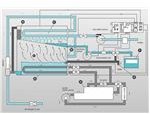
Freshwater generator flow of feed water is taken from the flow of seawater coolant. Feed water enters the lower (evaporator) section of the plate pack, in which the plates are warmed by the heating medium. The heating medium is either engine jacket cooling water or a closed circuit heated by steam. Here the water is evaporated at around 40-60°C in a vacuum of 85-95%, which is maintained by the brine/air ejector.
The vapour produced rises between the plates into the middle (separator) section of the plate pack, where any droplets of entrained seawater are removed. Gravity causes these droplets to fall back into the brine sump at the bottom of the freshwater generator.
AQUA freshwater generator operating principle
Only clean freshwater vapour reaches the top (condenser) section of the plate pack, which is cooled by a flow of seawater. Here the vapour is condensed into fresh water, which is pumped out of the freshwater generator by the freshwater pump.
AQUA freshwater generator process and utility plates

Generating Drinking Water on Ship - The Magic Machine


How is fresh water generated on a ship?  Is it possible to generate drinkable fresh water from sea water? 

Yes and for this purpose, a fresh water generator is used on a ship.This article will show the arrangement and working of a normal fresh water generator on a ship.

Introduction
fwg1

Fresh water is of dire need on a ship. It is used for various purposes such as drinking, for preparing food, in laundry services and in many other day to day activities. In the past, people used to carry tons and tons of fresh water in barrels or in specially made tanks. This was because there were no other sources of fresh water once the ship was in sea, except rain, which was quite unpredictable.
Today in spite of means on board to generate fresh water,  ships carry tons and tons of fresh water in segregated fresh water tanks. But there are many other processes in which fresh water is used and as generally the fresh water tanks provided are not sufficient, the need arises to generate fresh water onboard. Fresh water is always in dearth also because it is very difficult to keep a check on the water usage by the crew members and also the usage cannot be avoidable as water is continuously required onboard ship.
Fresh water is generated on ship by a fresh water generator, also known as evaporator. The process by which fresh water is generated is known as distillation process. Sea water is converted into fresh water by evaporating and condensing the sea water. Evaporation of the sea water is either done by boiling or by flash process. This process enables the reduction of 32,000 parts per million in sea water to 1 to 2 parts in fresh water. Fresh water generators can be tube type or plate type.

Single stage fresh water generator

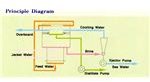
A fresh water generator consists of mainly two parts. A condenser and an evaporator. The boiling process is done either by a heating coil or by using the high temperature main engine jacket water. In some FWGs, heating is also done by superheated steam. Generally water is boiled at 100 degree Celsius, but in freshwater generator it is done at around 60-70 degree Celsius. For this purpose, educators or air ejectors are use. Eductors reduces the chamber’s pressure to such a point that water starts boiling at a temperature of 60-70 degrees Celsius. A flow meter is used to regulate the flow of sea water into the generator. The freshwater generated in the condenser is later collected by a distillate pump. A salinometer is used to check the salinity in the fresh water generated.
fwg2


Working of the FWG

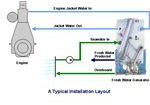
The hot jacket water from the diesel engine is passed through the evaporator’s heated nest. The sea water enters the evaporator through the flow meter and due to the low pressure of the chamber; it boils and gets converted to steam. Generally the feed of the seawater is kept half the stated quantity to facilitate adequate boiling of sea water. The steam then passes through a steam separator, in which the water particles in the steam are separated and collected.
The steam then enters the condenser, where it cools down to form fresh water. It is then removed from the condenser with the help of a distillate pump. The remainder sea water particles or the brine which gets collected at the bottom is drawn out with the help of an ejector pump.
fwg3fwg3


Flash process- Increasing the efficiency

A liquid which is already having sensible amount of heat when introduced in a pressurized chamber, immediately gets converted to steam, i.e. in a flash, without the boiling process. Thus the phenomena can be used to acquire higher level of efficiency by controlling the exact pressure and temperature of the water, which will lead to higher energy efficiency.
This can be done by using a double stage fresh water generator.
fwg5

Monday, 26 January 2015

Fresh Water Generators - How They Work

Introduction

During old times, all kinds of ships that were travel on waters for more than a few hours were supposed to carry tanks upon tanks of fresh water to provide for the crew of the ship. They were used not just for drinking and cooking but also for bathing. However, if there was a shortage of clean water due to unforeseen circumstances, then people would have to resort to consuming unclean sea water that is very harmful (may even lead to fatal diseases). In todayĆ¢€™s times, however, there is the fresh water generator which is hauled up on ships instead of gallons of water. It is a kind of an evaporator which is able to convert sea water into drinkable and clean water.

How it works

A typical fresh water generator uses the heat of the ship to convert sea water into clean and consumable water. The basic purpose is to boil out the bacteria in the sea water by using the heat. However, even though the idea is ingenious, it is hard to cleanse the water only through the heat from the engine since that can only heat water till about sixty or seventy degrees Celsius while water needs to boil at least a hundred degrees Celsius before it is pure. Thus, marine engineers have equipped the generator to evaporate the water which has not boiled to the maximum level.

Principles

A fresh water generator typically allows the vacuum water to boil at a temperature much lower than that being used for the cleansed water. When vacuuming, the temperature of the water really comes down and thus, one is able to boil the water properly, allowing it to be consumed. Basically, the following things are required for fresh water generators to function properly:

  1. the evaporation unit
  2. whole casing
  3. the ejector unit
  4. saline meter unit
  5. condenser unit

Each part and component has its own job in the entire process of water cleansing.

Mostly, a fresh water generator is started when the ship has traveled far enough and consistently enough for the temperature of the engine to be stable and consistent as well. For most ships, it is best to wait at least twelve nautical miles before starting the generator. For that particular distance, one must store up clean drinking water. After that, the outer supply jacket is open so that the water from the sea starts pouring into the machine. The evaporative unit is turned on as well and the generator begins working.

Then, the ejector starts working so that the vacuum slowly builds up and the sea water feeding pump is turned on as well. Slowly, the vacuum will build up and enables all salt elements in the water to remain behind as the contaminated water evaporates away. Sometimes, the leftover salt particles are used for cooking purposes as well. After that, the liquid has to go through the demister plate which allows all huge particles to be caught on the net so that it does not enter the condensation unit. After that, the sea water condenses the newly made fresh water and pure water is ready for use and is available to the ship crew. After the entire process, a last step requires the water to go through a saline meter so that one can check if it has the required PPM level of salt content in it - not more or less than the required amount.


Thus, a fresh water generator is basically a must have for maritime travel and one must make sure that when ships are sent out to carry cargo, some space is left for the generator. It is a great backup to possess, especially if an emergency ever occurs.

For more Fresh Water Generators information,join us at here.

Friday, 2 January 2015

How Ultrasonic Cleaning Works

By definition, ultrasonic cleaning refers to the complete and rapid removal of all contaminants from objects through the process of immersing them into a tank of liquid that is flooded with high frequency sound waves. A scrubbing action within the fluid itself is created by these sound waves that are non-audible. This particular process occurs through a high frequency electrical energy which is converted into sound waves of high frequency by a transducer. This is then known as ultrasonic energy. The transducer, being the core of the unit, is form where it derives its ability to clean the most difficult of substances from items. The transducer’s performance is from where the cleaning power of the unit stems.

The cleaning time as well as the efficacy achieved during the cleaning cycle both are affected by the efficiency of the transducer. More power is used by a transducer of poor quality and it also takes a longer time to clean the objects as compared to a transducer of good quality. This is the reason why it is wise that one should invest in a benchmark transducer so that they can benefit from a faster and more efficient cleaning unit.

The rapid formation as well as the collapse of minute bubbles is caused when the ultrasonic energy enters the liquid within the tank. This phenomenon is called cavitation. Before imploding against the surface of the item, the bubbles start to increase in size rapidly as they are immersed in the tank with a huge energy release that lifts all the contaminants off of the surface as well as the innermost recesses of parts that are intricately shaped.

Ultrasonic cleaning has become the first choice in industries all over for more than twenty five years due to its ability to clean hinges, box joints as well as threads both effectively and quickly. When cleaning items though, there are a lot of variables that need to be taken into account. These include time, frequency, heat, power and detergent type as they all have an effect on the cleaning process. However, the flexibility of ultrasonics can incorporate all of these into the process so as to achieve results that are the most effective.

When the cavitation occurs as the bubbles implode, the gaps that are left by the bubble are filled quickly by the cleaning solution. As the fluid comes into contact with the surface of the item, all the contaminants that are present are removed.

Sometimes people get confused as to whether to use spray washers or undertake ultrasonic cleaning. Aqueous spray washers are ideal for a great many cleaning applications. Stand alone basket washers and multistage conveyorised equipment both can often attain quick throughput as well as high standards of cleanliness. In a few cases, soils that are heavy are better dealt with spray washing because of the impact of the pumped cleaning solution through the wash jets.

In other instances though, ultrasonic cleaning and spray washing both might attain the standard of cleanliness that is required as well as the throughput requirements. This makes the choice dependent on either preference or cost.

Though there are applications in which ultrasonic cleaning units offer a clear cut advantage over the spray washers. Examples of such instances include:
  • Tubular components
  • Lightweight or delicate components that may be susceptible to damage
  • Components that may have deep or blind holes or other kinds of complex geometries


When achieving cleanliness standards that are measured in parts per billion or when achieving sub micron cleanliness standards then also ultrasonic cleaning is preferred over the use of spray washing. 

More Ultrasonic Cleaning services for marine sectors visit http://heatecholdings.com/

Thursday, 1 January 2015

Features to Look for in Fresh Water Generators

One of the most prominent reasons for using a fresh water generator is to convert sea water to fresh water in a short period of time. While doing it manually is almost nearly impossible, these generators have been particularly manufactured in order to carry out this task at all times and that too, without giving people much issues in the matter. These generators are currently available in the market at different prices which always tend to vary from brand to brand and model to model. Many factors have to be taken into thorough consideration before purchasing this generator as it has a lot of distinctive features.

Interface
Something that really must be noticed and checked before investing in a fresh water generator is the interface. The interface of generators always varies from one another and the best one is most definitely going to have an easy to follow interface that displays everything without creating an issue. Most generators, however, have intricate interfaces, which is why a lot of people may find it difficult to use them in the first place. However, since the technology has progressed by a long shot these days, high end generators for converting sea water to fresh water now have easy to comprehend interfaces which makes using them very simple on a day to day basis.

High Efficiency
The efficiency of a fresh water generator is another significant thing to be checked thoroughly beforehand. Since the conversion of sea water to fresh water can be a long process at times, the output is equally important. Due to that, it is important for a generator to have a good amount of efficiency in the first place. Generators having high end efficiency produce the best results and that too, in the least possible time. Generators with high end efficiency as a feature are always a great purchase.

High Quality Motor, Pipes & Pumps
Features such as piping as well as the motors must be reviewed in great detail as that is directly linked with the conversion of sea water to fresh water. Generators with high end pumps, motors as well as pipes are definitely more efficient and less time consuming, which makes them a great investment for anyone who is looking water to have fresh water in abundance at all times. A fresh water generator needs energy efficient motors as well as top quality pipes in order to provide positive results without giving any trouble to people.

Easy Usage

An essential thing for people to know is that a fresh water generator must be always be easy to use and control on a day to day basis. A lot of such generators can be hard to understand, making it impossible for anyone to run them without struggling a lot. This can be fully eliminated by going for a generator that has been ranked high by the general public. General reviews as well as testimonials can always be found online and that surely is going to help people in the process of choosing the best generator that converts sea water to fresh water in record time.

Easy & Flexible Installation


Almost anyone can use these generators as they have been created to be used by anyone and everyone. Due to their easy and simple interfaces, these have become a great way for people who are looking forward to convert sea water to fresh water in the long run. These generators can be installed anywhere, within ships as well as water plants, where they are surely needed the most. As far as prices are concerned, they usually can be found online and interested buyers are highly recommended to find the most efficient ones amongst these generators only to benefit from them in the future. 

More fresh water generators quotation, visit Heatec Jietong Holding Ltd in Singapore

Wednesday, 24 December 2014

How Fresh Water Generators Work

A fresh water generator is amongst the most important things on a marine ship. With its assistance, one can easily get a fresh supply of water for the entire voyage without the fear of ever running out of conserves. This brilliant machine works to convert salty seawater into pure, drinkable water which is also used for bathing and cooking. It also produces clean water needed to run other machines as well. Thus, simply put, it is not a machine the crew on the ship or the travelers can do without. Most of the times, these generator are produced on the shop using methods like the evaporation method wherein the salt is removed from seawater.

The fresh water generator typically needs two things in abundance in order to properly function. First and foremost, it needs plenty of saltwater and secondly, it needs heat. Both of them are readily available on a trip. Typically the heat is taken from the waters used in the main engine jacket. Even though these waters are used for cooling, most of the times, the average temperature at which it functions is seventy degrees Celsius. However, the heat is still not enough since water boils at at least a hundred degrees Celsius. Thus, one will have to create a vacuum inside the chamber where water is set to evaporate. When the water is cooled down, it is collected and then transferred into the tank out of which water is used by the crew for different purposes. 

As for the actual body of the fresh water generator, it is not that complex. The main component of the body is a huge cylindrical component which has two distinct components. While one of the components condenses the water body, the other one works at evaporating it. Of course, there are also a number of pipes and valves to allow the water to travel to different parts of the generator. There is also an educator which is supposed to generate the required vacuum. There are also two types of pumps; the fresh water pump and the ejector pump which helps with the water flow through the generator.

Moving on, the crew of the ship must also learn how to start the fresh water generator. In order to make sure that the water that goes into the generator is purely seawater and not water that also consists of city waste, one must make sure that they are at least twenty nautical miles away from the shore of the city and that the water pumping into the generator is not that of a congested canal. The engine must be above 50 rpm so that the water is properly warmed up. After that, each and every valve of the generator must be checked to make sure that it is not clogged.

After that, look for the seawater pump in the fresh water generator and make sure that the pressure of the pump is good and then, wait for the vacuum to build up. After ten minutes, when the vacuum has accumulated to ninety percent, open the valve for the treatment process to begin. Afterwards, the hot water inlets and the outlets should be opened up slowly; half of them can be opened in the beginning. When the vacuum drops to eighty-five percent, open the fresh water valve to let the water out. Check it for purity using the appropriate appliances and only after that allow the water to travel to the tanks of the ship.


A fresh water generator truly is the best backup to have on a voyage since when one is on the sea, they never know for sure what problems may befall them. It is good to know that one has an unlimited supply of pure water. 

More Fresh Water Generators details here.

Thursday, 11 December 2014

Advantages of Hiring Process Skid Providers

Process skid systems are usually installed in plants as such places in order to provide the workers with a good amount of accessibility as well as integration from one workstation to another. These are being used since many years more and have proven to become the best way to run things within huge factories and plants. The traditional system has been outdated now and that requires manual work, which takes up too much time as well as efforts. In light of what these systems have to offer, individuals should definitely hire the service providers of these systems in order to attain all the benefits and services they have to offer.

Wide Range of Designs
The design of a process skid system tends to vary from plant to plant. This means that individuals can customize the designs of these systems according to the way they want or prefer. The service providers of these systems are known to actually provide a wide range of various designs that are not only unique, but they are also rather practical for implementation purposes. All sorts of design consultation and everything related to that is also offered in order to help plant owners find the most adequate system in the long run.

Swift & Efficient Installation
On the other hand, the providers of process skid systems also provide high end installation to anyone who acquires their services. The installation process may take a while, but with efficient service providers, it hardly and does and within a short period of time, these systems are installed where they are supposed to be. Most service providers do not charge extra for installation but instead provide it for free as a complementary benefit to the individuals who attain their services. What’s best is the fact that the installation process is actually easy to follow and does not create any kind of trouble that may disturb the workplace.

Proper Consultancy
Another thing that the service providers of the process skid systems offer is high end consultancy. This is the part which matters the most as it allows individuals to know everything there is about these systems and how they can benefit several plants and such workplaces in both the short as well as the long run. Most service providers provide both regular and premium consultancy; therefore, individuals can always go for the one that they find more adequate for the kind of work they have.

Ensuring Smooth Integration
Since the process skid systems are specifically made for the purpose of integrating them with the other ones, this really has to be made sure by checking these systems after they have been installed. High end service providers always do check-up these systems after they have been installed and are set to be used for different purposes. The integration is the overall key, which is precisely why it has to be ensured in the first place. The service providers always ensure smooth running and integration of the new system with the existing ones in order to provide high end satisfaction to all of their customers.

Testing & Tubing

All sorts of testing as well as tubing are also taken care of by the providers of these systems. This is due to the fact that all the technical information and setup is taken care of by them. The purpose of testing and process tubing is to ensure seamless running of the system in the near future. These systems may not work best if they are not installed properly, which is why hiring service providers of these systems is definitely an important task that must not be missed out at any cost. With all these prominent advantages, hiring the service providers of these systems is truly a must. 

More process skid and modular structure information here.